
The Great Bathroom Trade-Off
United Kingdom and United States · 2026 Houzz surveys of recent, current and planned bathroom projects
A bath takes up space whether anyone uses it or not. Houzz's 2026 UK and US surveys offer a useful view of what happens when it comes out: a larger shower is the most frequently reported use of the space. Yet removing the bath remains a minority decision in both survey samples.
By The Room Study · Published
Data: 2026 Houzz surveys of recent, current and planned bathroom projects · Sources checked 17 October 2026
Key findings
In Houzz's 2026 UK survey, 17% of renovating homeowners reported removing a bath altogether. Source
Link to findingIn Houzz's separate 2026 US survey, 26% of renovating homeowners reported removing a bath altogether. Source
Link to findingAmong bath removers in the 2026 UK Houzz study, 85% used the space to enlarge the shower. Source
Link to findingAmong bath removers in the 2026 US Houzz study, 79% used the space to enlarge the shower. Source
Link to finding
Two surveys, two groups of renovators
The comparison starts with people already engaged in a bathroom project. Houzz surveyed 569 UK homeowners in June 2026 and 1,619 US homeowners in August; both studies appeared on 30 September 2026. Their answers cover recent work, projects in progress and plans. They therefore offer a view of renovation choices within Houzz's community, with all the selectivity that involves.
Country labels help us keep those groups separate. The results cannot tell us the proportion of all British or American homes losing a bath, nor whether the differences would remain in nationally representative samples. I would use them to identify a decision worth discussing with a designer, without treating either country as a model to follow.
What fills the space
Among respondents removing a bath, 85% in the UK study and 79% in the US study used the space for a larger shower. Those percentages have a smaller denominator than the removal figures. They describe what happens within the bath-removing group, whose exact size Houzz does not publish.
A bigger shower may be the appealing consequence of losing a little-used bath, but these results do not establish that removing one is necessary to enlarge a shower. Nor do they show that every project made a single exchange. A room can gain shower space and change its storage at the same time; the reported uses of released space are not a set of exclusive slices.
When the bath comes out
Separate survey measures. The second panel includes bath removers only.

Data: Houzz, 2026 UK and U.S. Bathroom Trends Studies. Analysis and chart: The Room Study. Overall samples: UK 569; US 1,619. Bath-remover subgroup counts are not published. Method and limits
Download chart (SVG)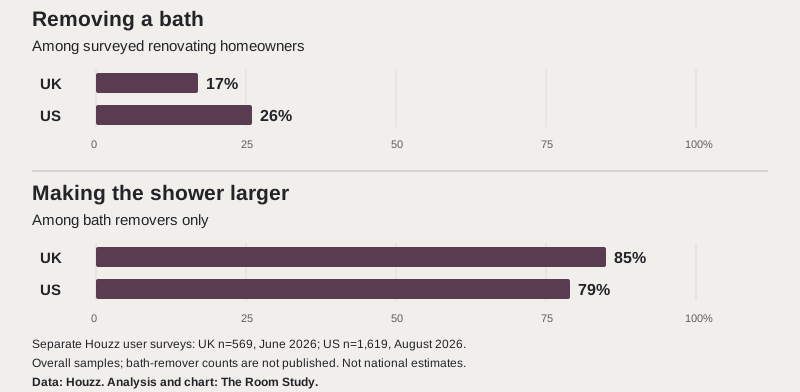
| Measure | Denominator | UK | US |
|---|---|---|---|
| Removing a bath | Surveyed renovating homeowners | 17% | 26% |
| Enlarging the shower with that space | Bath removers only | 85% | 79% |
There is still a substantial place for the bath
The UK findings resist a simple story of baths disappearing. Houzz reports that 58% of its surveyed renovators were adding or replacing one. It also reports a five-percentage-point fall in removal compared with its previous study. That is a change in the published survey share, not a count of baths saved across the country.
Keeping an existing bath, replacing it and installing one where there was none are different choices. Combining them into a single vote for or against bathing would hide the starting point. The decision in an already cramped bathroom may also differ from the decision in a home with another bathroom available. The comparison does not resolve those household circumstances.
The daily work of a bathroom
Ease of cleaning and disinfection was a functional priority for 74% of the UK sample. Meanwhile, 36% were adding or updating an accent wall. Both figures come from the 2026 UK study, but they answer different questions. A practical priority and a decorative intervention can belong in the same room.
My reading is that a renovation brief should make room for both. An arresting wall does not explain where the cleaning supplies will go, and a generous shower still needs somewhere useful for the bottles. These are questions to put to the plan. The survey does not test a particular tile, finish or storage solution, and cannot certify that a pictured bathroom will be easy to maintain.
Bring the comparison back to your own room
Before giving the bath's footprint to something else, record how it is actually used. Include the occasional uses that are easy to forget when drawing a room around the morning shower. Then compare two plausible layouts: one that keeps a bath and one that releases its space. The point is to make the gain and the loss visible enough to judge.
A percentage cannot weigh the pleasure of a regular soak against the irritation of squeezing past the basin. It also cannot establish a property's resale outcome. For our purposes, the useful trade-off is specific: what the extra shower space would let the household do, and what removing the bath would take away.
Methodology & sources
These are descriptive comparisons of published aggregate percentages, not a new survey. We checked the original reports and publisher releases on 17 October 2026. The UK survey was fielded to Houzz users in June; its brief methodology does not specify weighting. The US survey used email invitations to registered users in August and weighted results to Houzz's user population. Neither report establishes national representativeness.
The studies include completed, current and planned projects. The US eligibility window was completion within the previous 12 months, a project under way, or a planned start within three months. The UK report does not give equivalent eligibility detail. The reports label the project period 2025-26, so the study year should not be read as a count of work completed during 2026 alone.
UK report pages 27-28 have footnotes that conflict with their narrative. For the bath figures, we follow the narrative and Houzz's explicit UK press release: removal and adding/replacing use the renovating-homeowner base; shower enlargement uses bath removers. The US bases appear on pages 29-30. UK cleaning and accent-wall figures appear on pages 16 and 14.
Exact question wording, item-response counts and bath-remover subgroup sizes are not supplied. We retain Houzz's rounded values without estimating counts, pooling countries or testing differences. The reported five-point UK change has not been independently reproduced from raw data. Sampling, selection and reporting uncertainty remain; the results do not establish cause and effect.
We review these resources when the underlying releases change. A review date does not make a figure expire: its measurement period stays visible until a checked revision replaces it.
2026 UK Houzz Bathroom Trends Study
- Publisher
- Houzz
- Release
- 2026-09-30. Original PDF and publisher release checked 17 October 2026. Methodology: PDF page 35.
- Coverage
- United Kingdom. UK homeowners using Houzz with completed, current or planned bathroom renovation projects. 2025-26 projects; fieldwork June 2026.
- Method
- Online survey fielded to Houzz UK users. Recruitment, item-response counts, weighting and response rate are not described in the downloaded methodology. Not stated in the UK report; do not assume US weighting applies. Not a nationally representative homeowner sample. Overall sample: 569. Exact item-response and bath-remover subgroup counts are not published.
- Reuse
- Selected numerical facts with attribution and original TRS chart design. Houzz reports, charts, photographs and logos are not redistributed. No endorsement implied.
2026 U.S. Houzz Bathroom Trends Study
- Publisher
- Houzz
- Release
- 2026-09-30. Original PDF and publisher release checked 17 October 2026. Methodology: PDF page 62.
- Coverage
- United States. US registered Houzz users aged 18+ who own their home and completed a bathroom remodel/addition in the past 12 months, are working on one, or plan to start in the next three months. 2025-26 projects; fieldwork August 2026.
- Method
- Online 110-question survey, recruited by email to registered Houzz users. Weighted to Houzz user populations using weights from the annual Houzz & Home Study. Not a nationally representative homeowner sample. Overall sample: 1,619. Exact item-response and bath-remover subgroup counts are not published.
- Reuse
- Selected numerical facts with attribution and original TRS chart design. Houzz reports, charts, photographs and logos are not redistributed. No endorsement implied.
Cite this research
Credit the original source when using its estimates. For our derived comparisons, credit The Room Study analysis and retain the population and dates.
The Room Study (2026). The Great Bathroom Trade-Off. Published 17 October 2026. https://theroomstudy.com/statistics/bathroom-renovation-trade-offs. Based on Houzz and Houzz data; measurement period: 2026 Houzz surveys of recent, current and planned bathroom projects.
CSV: attributed published figures, their response bases and source notes. No new estimates or respondent counts. Please keep the source attribution and methodological notes with any reuse.