
Spare bedrooms in England: what counts as spare?
England · 2024–25; overcrowding uses a three-year average
The spare room may have a bed, a desk and a drying rack, with all three making a reasonable claim to the floor. Calling it spare tells us surprisingly little about its working week. In England, around 40% of households were classed as under-occupying in 2024–25. The definition is narrower than everyday conversation: at least two bedrooms above the bedroom standard.
By The Room Study · Published
Data: 2024–25; overcrowding uses a three-year average · Sources checked 22 October 2026
Key findings
39.8% of households in England were under-occupying according to the bedroom standard in 2024–25. Source
Link to finding54.7% of owner-occupying households in England were under-occupying according to the bedroom standard in 2024–25. Source
Link to finding15.0% of private-renting households in England were under-occupying according to the bedroom standard in 2024–25. Source
Link to finding
Two bedrooms above a formula
The bedroom standard assigns a notional bedroom requirement using the ages, relationships and sex of household members. A couple is allocated one bedroom; another adult aged 21 or over is allocated their own. Children and younger people are paired under specified rules. The survey compares that requirement with the bedrooms available to the household.
One bedroom above the standard does not qualify as under-occupation here. Nor does the classification tell us that two rooms stand empty. Rooms converted to other uses are excluded unless respondents still describe them as bedrooms. That detail matters when the guest bed and the working desk share an address.
A very different picture for owners and renters
The national average conceals a large tenure gap. The annex records under-occupation in 54.7% of owner-occupying households, 15.0% of private-renting households and 9.5% of social-renting households. Each percentage describes households within that tenure, rather than its share of England’s under-occupied homes.
The distinction changes the design conversation. An owner deciding what to do with an extra bedroom and a renter fitting a desk beside the bed may both want a more useful home, but they begin with very different choices. A room makeover cannot supply the missing floor area.
Under-occupation by tenure in England
Households with at least two bedrooms above the bedroom standard, 2024–25

Data: MHCLG, English Housing Survey 2024–25, Annex Table 1.3. Chart: The Room Study. Each bar uses households in that tenure as its denominator; this does not count empty rooms. Method and limits
Download chart (SVG)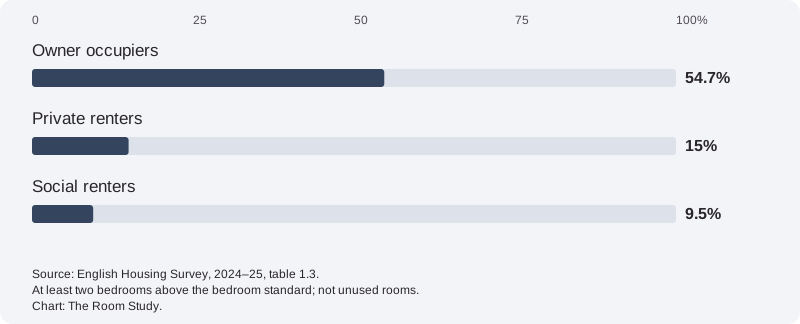
| Measure | Share of households | Estimated households | Survey basis |
|---|---|---|---|
| Under-occupation: all tenures | 39.8% | 9.952 million | 2024–25; all households |
| Under-occupation: owner occupiers | 54.7% | 8.858 million | 2024–25; owner-occupying households |
| Under-occupation: private renters | 15.0% | 705,000 | 2024–25; private-renting households |
| Under-occupation: social renters | 9.5% | 389,000 | 2024–25; social-renting households |
| Overcrowding: all tenures | 3.3% | 824,000 | Three-year average: 2022–23 to 2024–25 |
A bedroom can have more than one use
A bed kept for a visiting parent has a purpose even on the nights nobody sleeps in it. So does a room used for sewing, quiet work or possessions that need somewhere accessible to live. These are possible uses, not findings from this table: the figures do not tell us what England’s spare rooms contain.
Before buying furniture for a spare room, write down what actually happens there over a month. A room that works daily as an office and occasionally as a bedroom needs a different arrangement from a guest room with a laptop balanced on the dressing table. The door still has to open when the bed is in use.
Keep overcrowding in view, and its dates separate
The same release estimates that 824,000 households were overcrowded, meaning they had fewer bedrooms than the standard required. Its annex gives 3.3%. That estimate combines three survey years, from 2022–23 to 2024–25, because the annual overcrowded sample is small. It should not be subtracted from the single-year under-occupation figure to produce a neat national space balance.
Start with the room’s obligations
For a room with several jobs, decide what must remain available and what can be moved without a major performance. A visitor needs somewhere for a bag; a working day needs space to pull the chair back. Keeping those small requirements visible is more useful than furnishing for a photograph and discovering later that the suitcase blocks the desk.
These statistics describe how bedroom provision is distributed. They cannot decide whether somebody should downsize or surrender a useful room. The practical question at home is more specific: whose needs must this space accommodate, and can they use it without clearing somebody else’s things first?
Methodology & sources
Source: MHCLG English Housing Survey 2024–25, Chapter 1: Housing quality and its Annex Tables 1.2 and 1.3, published 29 January 2026. The Room Study downloaded the official ODS and checked its displayed table values on 22 October 2026. Geography is England, not the United Kingdom.
Under-occupation uses the full 2024–25 household sample. Annex Table 1.3 reports 16,438 sampled households: 8,366 owner occupiers, 3,538 private renters and 4,534 social renters. Counts and percentages are weighted population estimates, not counts of surveyed people. The annex publishes household estimates in thousands; their precision should not be mistaken for an exact census count.
The chart and table retain the annex’s one-decimal percentage values. The lead rounds 39.8% to 40%, as the official narrative does. That narrative also rounds 54.7% to 55%, 9.5% to 10%, and 9.952 million households to 10.0 million. The apparent differences are rounding, not competing estimates.
The bedroom standard compares available bedrooms with a requirement based on household composition. Under-occupation means two or more bedrooms above that requirement; overcrowding means fewer bedrooms than required. Converted bedrooms are excluded unless respondents still identify them as bedrooms; unused habitable bedrooms are counted. The measure does not record empty-room frequency, room dimensions or satisfaction with the use of space.
Overcrowding uses the pooled 2022–23, 2023–24 and 2024–25 surveys, presented as a three-year average ending in 2024–25. Annex Table 1.2 reports a total sample of 43,489. It is shown as separate context and is not combined with the single-year under-occupation figures in the chart or used to calculate a residual category.
Room-planning observations are The Room Study’s editorial interpretation. The survey did not test furniture arrangements, measure spare-room use or demonstrate that any product improves household wellbeing.
We review these resources when the underlying releases change. A review date does not make a figure expire: its measurement period stays visible until a checked revision replaces it.
English Housing Survey 2024 to 2025: housing quality, Annex Tables 1.2 and 1.3
- Publisher
- Ministry of Housing, Communities and Local Government
- Release
- 2026-01-29. The chapter rounds under-occupation to 40%, 55%, 15% and 10%. The downloaded annex gives 39.8%, 54.7%, 15.0% and 9.5%; the chart and table retain that published precision. The annex gives 9,952 thousand under-occupied households and 824 thousand overcrowded households. Verified against the official ODS on 22 October 2026.
- Coverage
- England. Households in England; tenure-specific percentages use households in that tenure as the denominator.. Under-occupation: 2024–25. Overcrowding: pooled 2022–23, 2023–24 and 2024–25, labelled 2024–25..
- Method
- English Housing Survey, full household sample, weighted population estimates. Bedroom availability is compared with the bedroom standard based on household composition. Under-occupation requires at least two bedrooms above that standard. Overcrowding requires fewer bedrooms than the standard and uses a three-year average because annual overcrowded samples are small. Annex Table 1.3: 16,438 households in 2024–25 (8,366 owner occupiers, 3,538 private renters, 4,534 social renters). Annex Table 1.2: pooled sample of 43,489 (21,694 owner occupiers, 9,268 private renters, 12,527 social renters)..
- Reuse
- Crown copyright 2026. Open Government Licence v3.0. Selected table aggregates reproduced with attribution; chart and editorial interpretation by The Room Study. Source reuse information
Official chapter and rounded headline figures · Annex tables and publication date · Original annex workbook (ODS) · Bedroom standard: official definition
Cite this research
Credit the original source when using its estimates. For our derived comparisons, credit The Room Study analysis and retain the population and dates.
The Room Study (2026). Spare bedrooms in England: what counts as spare?. Published 22 October 2026. https://theroomstudy.com/statistics/england-spare-bedrooms. Based on Ministry of Housing, Communities and Local Government data; measurement period: 2024–25; overcrowding uses a three-year average.
CSV: source estimates and The Room Study calculations. Please keep the source attribution and methodological notes with any reuse.