
A kitchen full of cupboards, and nowhere to put anything
United Kingdom, selected Houzz homeowner sample · 2026 Houzz study; fieldwork November–December 2025
A generous run of cupboard doors can still leave the chopping board on the floor and the recycling in everybody’s way. The question is what happens behind those doors. Houzz’s 2026 UK kitchen study gives a useful glimpse of the storage features chosen by people already renovating, with smaller, everyday arrangements as prominent as the larger fittings.
By The Room Study · Published
Data: 2026 Houzz study; fieldwork November–December 2025 · Sources checked 18 October 2026
Key findings
95% of surveyed UK Houzz cabinet upgraders included speciality storage. Source
Link to findingCutlery organisers were selected by 78% of surveyed cabinet upgraders. Source
Link to findingPull-out waste or recycling bins were selected by 55% of surveyed cabinet upgraders. Source
Link to findingDeep-drawer organisers were selected by 45% of surveyed cabinet upgraders. Source
Link to finding
A view of renovation choices
Houzz’s study surveyed 402 UK homeowners registered on its platform in November and December 2025. They had recently completed a kitchen renovation or extension, were working on one, or intended to start within six months. These are people engaged in a project, rather than a representative sample of every British kitchen.
Within the group adding or replacing cabinets, 95% included speciality storage. The feature choices were not mutually exclusive. One project could include a cutlery insert, a bin and a corner fitting, so the percentages describe overlapping decisions rather than separate shares of a single storage budget.
The small things deserve a drawing too
The selected features range from cutlery organisers to deep-drawer fittings and pull-out shelves. The figures suggest a useful starting point for a brief: identify what the cupboards are meant to hold before deciding how much of the room they should occupy. This is our design reading of the choices, not a measured result of the renovations.
A kitchen supplier can draw an attractive bank of doors without knowing the dimensions of your largest pan, the number of recycling containers you use or whether the children can reach their own bowls. Bring those objects and routines into the discussion. An internal layout is easier to judge when it has actual contents.
Storage choices inside upgraded cabinets
Selected features among surveyed homeowners adding or replacing cabinets. Multiple choices allowed; not all UK kitchens.

Data: Houzz, 2026 UK Kitchen Trends Study, page 26. Overall sample 402; cabinet-upgrader base count not published. Fieldwork November–December 2025. Original chart: The Room Study. Method and limits
Download chart (SVG)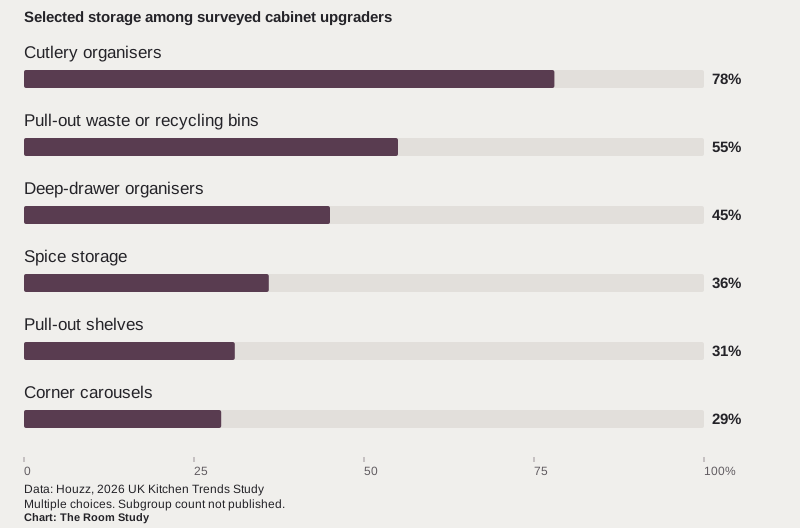
| Feature | Share | Population |
|---|---|---|
| Any speciality storage | 95% | Surveyed cabinet upgraders |
| Cutlery organisers | 78% | Surveyed cabinet upgraders |
| Pull-out waste or recycling bins | 55% | Surveyed cabinet upgraders |
| Deep-drawer organisers | 45% | Surveyed cabinet upgraders |
| Spice storage | 36% | Surveyed cabinet upgraders |
| Pull-out shelves | 31% | Surveyed cabinet upgraders |
| Corner carousels | 29% | Surveyed cabinet upgraders |
Count the contents before adding capacity
Start with one cupboard or drawer and take out what belongs there. Separate everyday items from occasional equipment, duplicates and things that have no kitchen role at all. Then measure the awkward pieces: the stockpot with its lid, the roasting tray, the chopping board and any appliance you expect to put away. Include handles and the space needed to take the object out.
The point is not to achieve a photographically empty worktop. A frequently used object can have a sensible place in view. The more useful question is whether leaving it there is a deliberate choice or the consequence of a cupboard that cannot accept it.
For an existing kitchen, this inventory can reveal whether the immediate problem is access, internal division or total capacity. Those lead to different experiments. A rearrangement or a removable insert may be enough to test an idea before replacing a cabinet; the survey provides no reason to assume a full renovation is required.
Plan the movement as well as the container
For a bin, draw the action of opening it while somebody is preparing food or using the sink. Check the container capacity, how liners are changed, and how each section is removed for cleaning. A concealed bin can be an attractive choice, but concealment alone does not tell you whether the arrangement will be convenient.
For a deep drawer, take the proposed internal dimensions seriously. Ask to see its usable height and the space occupied by runners, dividers and any inner drawer. Decide whether pans will be lifted out individually or remain in a stack. There is little benefit in specifying a named storage feature before knowing what will go into it.
An organiser can also become a constraint. Adjustable or removable divisions may suit contents that change, while a precisely fitted arrangement may be helpful for a stable set of equipment. Neither choice is certified by its position in a popularity chart. Check the particular fitting with the particular objects.
A difficult corner is a design question
A corner unit invites a mechanism because the space is awkward to reach. Before choosing one, compare the accessible storage it creates with the room it needs to move. Ask for the opening to be demonstrated, including the adjacent doors, handles and appliances. Measure the items you hope to retrieve from it rather than judging only the size of the cabinet shell.
The same exercise applies to a pull-out. Check the clear opening, internal width, loading guidance and whether the whole arrangement can be reached comfortably by the people using the kitchen. A mechanism has to suit the household’s reach and strength as well as the drawing.
Where a new layout is possible, compare the corner solution with a different cabinet arrangement. Where the shell is staying, establish compatibility before ordering an insert. A feature’s popularity does not establish that it will fit an existing carcass or make its entire volume usable.
Give every storage choice a job
A useful storage brief can be short: what needs a home, how often it is used, who needs to reach it and the clear space it requires. Add where it is used and where it returns after washing. This makes the discussion with a designer or supplier much more specific than a request for more storage.
Keep one awkward routine in the plan as a reality check. It might be unloading the dishwasher while another person makes tea, taking out recycling with the bin open, or putting a heavy appliance away. Mark the open doors and drawers, then see whether the proposed arrangement still lets the household move.
The figures describe what other renovators selected. Your decision is whether a fitting makes an actual task easier in your own kitchen. Before buying another cupboard, give the cupboards already in the drawing a list of things to do.
Methodology & sources
Source: original report pages 26 and 38, checked 18 October 2026. The 2026 edition reports November–December 2025 fieldwork. Eligible users were homeowners aged 18 or over, with work completed within the previous 12 months, under way, or planned within six months.
Page 26 specifies cabinet upgraders as the base. Houzz supplies neither their exact count nor item-response counts. Its brief methodology does not establish weighting or national representativeness. The report mixes completed work with intentions; percentages are not completion rates for 2026.
We retain published rounded percentages without estimating respondent counts, pooling countries or testing differences. Features overlap. Selection does not demonstrate storage capacity, usability, satisfaction or value for money. The practical planning questions are editorial interpretation, not findings tested by Houzz.
We review these resources when the underlying releases change. A review date does not make a figure expire: its measurement period stays visible until a checked revision replaces it.
2026 UK Houzz Kitchen Trends Study: storage, page 26; methodology, page 38
- Publisher
- Houzz Research
- Release
- 2026-01-26. Houzz research page dated 26 January; press announcement dated 27 January. Original report checked 18 October 2026.
- Coverage
- United Kingdom. Adult homeowners registered on Houzz UK with an eligible kitchen renovation or extension. Online fieldwork November–December 2025; completed, current and planned projects.
- Method
- 70-question online survey. Eligibility: completed within the preceding 12 months, under way, or planned to start within six months. No national representativeness or weighting established. Storage percentages use cabinet upgraders and allow multiple features. 402 respondents overall; cabinet-upgrading subgroup and item-response counts not published.
- Reuse
- Selected numerical facts with attribution and original Room Study charts. No report, photography, questionnaire or respondent data redistributed.
Cite this research
Credit the original source when using its estimates. For our derived comparisons, credit The Room Study analysis and retain the population and dates.
The Room Study (2026). A kitchen full of cupboards, and nowhere to put anything. Published 18 October 2026. https://theroomstudy.com/statistics/uk-kitchen-storage-renovation. Based on Houzz Research data; measurement period: 2026 Houzz study; fieldwork November–December 2025.
CSV: source estimates and The Room Study calculations. Please keep the source attribution and methodological notes with any reuse.