
How temporary is a rented home?
England · 2024–25 household survey
The lamp can wait until you own somewhere. So can the curtains, and perhaps a chair you actually like. That is an expensive way to spend several years in a room you barely enjoy. England’s housing figures give this familiar postponement some perspective: private renters had lived in their current home for a mean of 4.7 years when surveyed in 2024–25. The number describes time already spent there; it cannot promise how much longer anyone will stay.
By The Room Study · Published
Data: 2024–25 household survey · Sources checked 22 October 2026
Key findings
Private-renting households in England had lived in their current home for a mean of 4.7 years in 2024–25. Source
Link to finding58.3% of eligible private-renting households in England said they expected to buy a property at some point, in 2024–25. Source
Link to findingAn estimated 640,000 households in England had moved from one privately rented home to another during the previous 12 months, in 2024–25. Source
Link to finding
Four years already lived, with no moving date attached
The English Housing Survey asks households about the home they occupy now. Private renters averaged 4.7 years, social renters 12.2 and owner occupiers 17.0. A household that arrived recently and one settled for much longer both contribute to those averages. The chart compares the same measure across the three tenures.
Calling 4.7 years the average tenancy length would change its meaning. These stays were still in progress at interview. Nor does the figure describe the typical renter’s remaining time or the total years they have rented across several addresses. For a particular household, the relevant horizon may be next summer, an uncertain renewal or no intended move at all.
Buying someday leaves quite a lot of living to do
In the buying-expectations question, 58.3% of eligible private-renting households expected to buy a property at some point. Among those expecting to buy and answering the follow-up, 37.6% put that prospect two years to less than five years away. The second percentage has a smaller base. Neither number records a completed purchase.
An eventual home of your own can be a sensible ambition without becoming the only home worth thinking about. A better reading light can make this evening more comfortable, even if the kitchen cupboards must wait. It is easier to judge a small change against something you do every day than against an imagined future dining room.
Time already spent in the current home
Mean years at interview, England, 2024–25; ongoing residence, not completed tenancy length

Source: MHCLG, English Housing Survey 2024–25, Annex Table 3.6. Mean current residence by tenure; full household sample 16,438. Contains public sector information licensed under OGL v3.0. Chart: The Room Study. Method and limits
Download chart (SVG)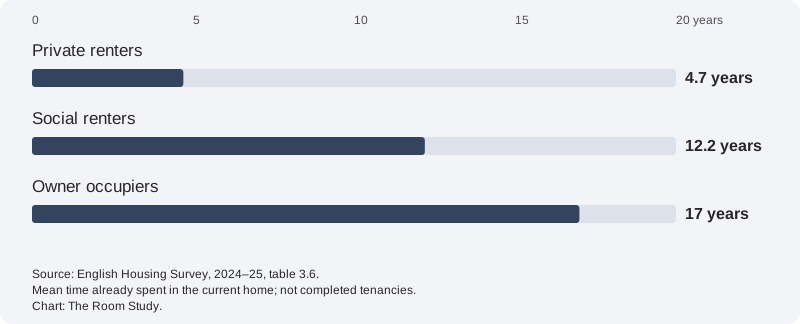
| Measure | Estimate | Who or what is counted |
|---|---|---|
| Private renters: mean current residence | 4.7 years | Elapsed time in the present home at interview |
| Social renters: mean current residence | 12.2 years | Elapsed time in the present home at interview |
| Owner occupiers: mean current residence | 17.0 years | Elapsed time in the present home at interview |
| Private renters expecting to buy | 58.3% | Eligible private renters answering; unweighted base 3,410 |
| Expecting to buy in 2 to less than 5 years | 37.6% | Private renters expecting to buy and answering timing; unweighted base 1,909 |
| Private-to-private moves in previous 12 months | 640,000 households | Estimated households with both previous and current tenure private renting |
The next move still deserves a place in the plan
The same survey estimates that 640,000 households had moved from one privately rented home to another during the previous twelve months. That is a weighted estimate of households, not the number of tenants, and it tells us nothing about whether those moves were welcome. A longer average residence and substantial movement can exist together.
For furniture you provide yourself, portability is worth considering alongside comfort. Check how a piece comes apart and whether it depends on one unusually accommodating alcove. Keep the assembly instructions somewhere more memorable than the drawer that will be emptied first. Before spending on alterations, establish what is agreed for the particular property; the survey says nothing about permission to decorate.
What would make the present room easier to live in?
There is no spending target hidden in these figures. Moving costs, furnished rooms and limited money can rule out purchases altogether. Rearranging what belongs to you, clearing the route around a bed or moving a lamp closer to the chair may answer the immediate problem. Bigger changes need to justify their cost and the effort of taking them elsewhere.
The useful question is specific: what am I putting up with because I expect to leave? Write that down before shopping. You may decide a difficult sofa is best left alone, while the light you use every night deserves attention. A rental’s uncertain future is real; so is the evening you are spending in it.
Methodology & sources
The English Housing Survey covers England. These household results are for 2024–25, based on interviews between March 2024 and March 2025 with 16,438 households. They are separate from the report’s physical-dwelling results labelled 2024. We checked the current official chapter, technical notes and downloadable Chapter 3 ODS annex workbook on 22 October 2026.
Annex Table 3.6 supplies the mean years in the current home. The selected values are its published one-decimal figures, with no new calculation. The table gives the full sample but not separate unweighted bases for the three tenure means. Current residence is an ongoing spell, so these estimates cannot be described as completed tenancy lengths, medians or predictions of remaining residence. Differences between tenures do not establish a causal effect of tenure.
Annex Table 3.4 excludes non-response and renters already owning property. The private-renter buying-expectation base is 3,410; the timing-question base is 1,909 private renters expecting to buy. We retain 58.3% and 37.6% as displayed in the workbook; the chapter rounds them to 58% and 38%. Intentions are distinct from later purchases.
Annex Table 3.7 covers household reference persons resident for less than a year. Its private-to-private cell displays 640 in thousands, reported here as 640,000 households. The underlying unrounded estimate is approximately 639,962 households. Its full recent-mover sample is 1,222 and the current-private-renter row has 659 respondents; the cell-specific unweighted count is not supplied. Unknown previous-landlord cases are excluded, and the survey cannot identify households that have ended.
These are weighted survey estimates, subject to sampling uncertainty. The original report tests comparative statements at 95% confidence; we make no new significance claims. Official estimates are used under the Open Government Licence v3.0. Suggestions about furnishing and portability are The Room Study’s editorial interpretation, not outcomes or recommendations tested by the survey.
We review these resources when the underlying releases change. A review date does not make a figure expire: its measurement period stays visible until a checked revision replaces it.
English Housing Survey 2024 to 2025: housing history and future housing
- Publisher
- Ministry of Housing, Communities and Local Government
- Release
- 2025-12-04. The annex tables were published on 4 December 2025; the chapter and technical notes show an update of 9 July 2026. Selected values were checked against the current Chapter 3 ODS workbook on 22 October 2026. The report rounds private-renter buying expectations to 58%; we retain the workbook’s displayed 58.3%.
- Coverage
- England. Households in England. Residence means cover current households by tenure. Buying expectations exclude non-response and renters who already own property; moves concern household reference persons resident for less than a year.. 2024–25; household fieldwork March 2024 to March 2025.
- Method
- English Housing Survey household interview estimates, weighted to represent households in England. Means describe elapsed residence at interview; buying expectations are self-reported intentions. The report’s comparative statements are tested at the 95% confidence level; we perform no new significance tests. 16,438 households overall. Annex Table 3.4: 3,410 private renters answered whether they expected to buy; 1,909 answered the timing question. Annex Table 3.7: 1,222 recent movers overall, including 659 currently private-renting households. Separate tenure bases for the residence means and the private-to-private mover cell are not supplied..
- Reuse
- Contains public sector information licensed under the Open Government Licence v3.0. Selected official aggregates reproduced with attribution; editorial interpretation and chart by The Room Study. Source reuse information
Chapter 3: housing history and future housing · Annex tables publication and release date · Chapter 3 annex tables (ODS) · Technical notes and glossary
Cite this research
Credit the original source when using its estimates. For our derived comparisons, credit The Room Study analysis and retain the population and dates.
The Room Study (2026). How temporary is a rented home?. Published 22 October 2026. https://theroomstudy.com/statistics/england-renting-and-home. Based on Ministry of Housing, Communities and Local Government data; measurement period: 2024–25 household survey.
CSV: source estimates and The Room Study calculations. Please keep the source attribution and methodological notes with any reuse.