
How big are new American apartments?
United States · new multifamily housing · 1999 to 2025
New rental apartments averaged 1,044 sq ft in the 2025 Census completions data; the median was 1,000 sq ft. These figures use finished residential building area per unit, including associated indoor space. They describe new multifamily housing, not the interior size of every apartment in America.
By The Room Study · Published
Data: 1999 to 2025 · Sources checked 13 November 2026
Key findings
The mean size of newly completed U.S. multifamily units built for rent was 1,044 sq ft in 2025, using the Census building-based measure. Source
Link to findingThe rental median was 1,000 sq ft in 2025. This includes an allocation of associated indoor space, rather than measuring only the area inside each apartment. Source
Link to findingThe Room Study calculates that the 2025 rental median was 5.4% below its 2015 estimate of 1,057 sq ft. This is a descriptive comparison, without a significance test. Source
Link to finding
What is the average size of a new US apartment?
For units built for rent, Census reports a mean of 1,044 sq ft and a median of 1,000 sq ft in 2025. The mean is the arithmetic average; the median marks the middle of the estimated size distribution. The table separates rentals from units built for sale, whose figures include condominium and cooperative housing.
“Apartment” is a useful everyday description, but the survey’s category is multifamily housing. It includes buildings with two or more units and some attached homes that do not meet the Census definition of single-family housing. Existing apartments and conversions within existing buildings are outside this series.
Are new rental apartments getting smaller?
Compared with 2015, the rental median was 57 sq ft lower in 2025, a fall of 5.4%. A longer view is less dramatic: the 1999 estimate was 1,012 sq ft, only 12 sq ft above the latest figure. The series has moved up and down, rather than falling steadily.
The 2024 estimate was 1,001 sq ft. A one-square-foot difference in the published point estimates gives little reason to announce a sudden squeeze. We have not tested these changes for statistical significance, and each year describes a different set of completed buildings.
New rental apartments: the longer view
Median floor area per newly completed rental multifamily unit (sq ft). Census building-based measure.

Source: U.S. Census Bureau, Characteristics of New Housing. Building-based area per unit. Point estimates; no significance test. Method and limits
Download chart (SVG)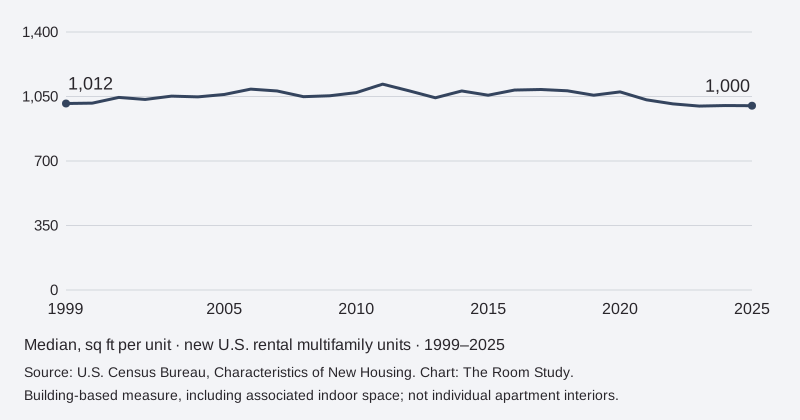
| Intended use | Median (sq ft) | Mean (sq ft) |
|---|---|---|
| Built for rent | 1,000 | 1,044 |
| Built for sale | 1,170 | 1,383 |
| All multifamily units | 1,004 | 1,058 |
View every year in the chart (1999 to 2025)
| Year | Median (sq ft) |
|---|---|
| 1999 | 1,012 |
| 2000 | 1,014 |
| 2001 | 1,045 |
| 2002 | 1,034 |
| 2003 | 1,052 |
| 2004 | 1,048 |
| 2005 | 1,061 |
| 2006 | 1,090 |
| 2007 | 1,080 |
| 2008 | 1,049 |
| 2009 | 1,054 |
| 2010 | 1,071 |
| 2011 | 1,117 |
| 2012 | 1,081 |
| 2013 | 1,043 |
| 2014 | 1,080 |
| 2015 | 1,057 |
| 2016 | 1,085 |
| 2017 | 1,088 |
| 2018 | 1,081 |
| 2019 | 1,057 |
| 2020 | 1,075 |
| 2021 | 1,032 |
| 2022 | 1,010 |
| 2023 | 998 |
| 2024 | 1,001 |
| 2025 | 1,000 |
Does 1,000 sq ft mean that much space inside the apartment?
Census divides a building’s finished residential floor area, measured using exterior dimensions, by its number of housing units. Associated indoor space includes halls, lobbies and elevator space. Garages and unfinished areas are excluded; in mixed-use buildings, only the residential portion is counted. Units within a building are assigned the same size category.
The result is useful for studying new construction, but it is not an individually measured floor plan. A listing that quotes internal or rentable area can therefore use a different basis. Before comparing two listings, find out what each includes; an allowance for a shared lobby will not make room for your dining table.
Why do apartment-size reports give different answers?
Check the homes being counted first. All occupied apartments, newly completed rentals and advertised apartments are different populations. A city sample can also look very different from a national one. Then check whether “average” means a mean or a median, and whether the area is measured inside the unit or allocated from the building.
The Census rental median of 1,000 sq ft converts to about 92.9 m². Changing the unit does not change the definition: it remains a building-based measure. It cannot be compared directly with the English Housing Survey’s usable floor area for existing houses and flats.
What can these figures tell you about a home?
They put new construction in perspective, but the floor plan still decides whether a home suits you. A long corridor, a badly placed door or a room with very little usable wall can matter more than a modest difference in the advertised total.
For a flat you are considering, measure the furniture positions and the routes between them. Check the delivery route too, especially lifts and stair turns. Our sofa-fit guide takes that decision from the national average to the doorway you actually have.
Methodology & sources
We transcribed the 27 annual national records in Census worksheet MFUMedAvgSqft, cells A10:G36, from the 2025 Characteristics of New Housing release published on 1 July 2026. The download retains rental, for-sale and all-unit medians and means, with the original worksheet coordinates. The chart shows the rental median only.
The percentage change is (2025 median / 2015 median − 1) × 100: (1,000 / 1,057 − 1) × 100 = −5.4%, rounded to one decimal. Area conversions use 1 sq ft = 0.09290304 m². Neither calculation changes the survey population or measurement basis.
These are Survey of Construction sample estimates, subject to sampling and nonsampling error. The workbook reports an average relative standard error of 1% for the national rental median and 16% for the for-sale median. These are not year-specific confidence intervals. We have not tested differences over time or between rental and for-sale units for statistical significance.
The floor-area definition and building-level allocation apply to both medians and means. Do not interpret the rental median as proof that half of individual apartment interiors are smaller than 1,000 sq ft. Built for rent or sale describes intended use; it does not count completed lettings or purchase transactions.
The series covers new privately owned construction. It does not measure all existing apartments, housing affordability or local minimum space standards. Annual changes can reflect a different mix of locations and buildings, rather than a change to otherwise identical homes.
We review these resources when the underlying releases change. A review date does not make a figure expire: its measurement period stays visible until a checked revision replaces it.
Characteristics of New Housing: square footage of multifamily units completed
- Publisher
- U.S. Census Bureau
- Release
- 2026-07-01. 2025 annual release. Original workbook, definitions and methodology checked 13 November 2026.
- Coverage
- United States. Newly completed privately owned multifamily housing units, classified by intended rental or sale use. Annual completions, 1999 to 2025.
- Method
- Survey of Construction. Finished residential building floor area on an exterior-dimensions basis is divided by the number of units; associated indoor space is included, garages and unfinished areas excluded. All units in a building are assigned the same size category. Survey estimates; not a census of every apartment or a measure of all existing homes..
- Reuse
- U.S. federal statistical estimates, attributed to Census. The Room Study supplies the chart, comparisons and source-linked extract. Source reuse information
Original square-footage workbook (XLS) · Official 2025 highlights · Survey definitions · Sampling and estimation · Multifamily questionnaire (PDF)
Cite this research
Credit the original source when using its estimates. For our derived comparisons, credit The Room Study analysis and retain the population and dates.
The Room Study (2026). How big are new American apartments? Published 13 November 2026. https://theroomstudy.com/statistics/us-apartment-size. Based on U.S. Census Bureau data; measurement period: 1999 to 2025.
CSV: annual Census source estimates and worksheet references. Please keep the source attribution and methodological notes with any reuse.