
When does the clean laundry get put away?
United States · 2–5 June 2025 survey
A load can be washed and dry while the job still occupies part of the home. In a 2025 YouGov poll, 31% of respondents who did their own laundry at least occasionally said they usually took a day or more to put it away after drying. The survey gives that final step a place in the numbers.
By The Room Study · Published
Data: 2–5 June 2025 survey · Sources checked 18 October 2026
Key findings
31% of respondents who did their own laundry at least occasionally usually took a day or more after it was dry to put it away. Source
Link to finding35% selected “right away” for how long after drying they usually put their laundry away. Source
Link to finding30% selected “a few hours” for how long after drying they usually put their laundry away. Source
Link to finding
The clock starts when the clothes are dry
The question concerns the interval between dry laundry and putting it away. It does not measure how often clothes are washed, how long drying takes or how long a washing machine sits full. Those are different points in a laundry routine, with different demands on the home.
Keeping the starting point clear makes the result more useful. A drying rack and a place for clean clothes awaiting storage have different jobs. Looking at one cannot tell you whether the other is needed, and this poll does not identify which rooms respondents use for either.
Some finish immediately; others leave a gap
The largest individual answer was right away, at 35%, followed by a few hours, at 30%. A day accounted for 16%, two to six days for 11%, and a week or more for 4%. Another 1% selected never and 3% were unsure. Keeping every answer visible avoids making either the immediate finishers or the longer waits disappear.
YouGov also publishes the combined 31% who take a day or more. That is consistent with adding the three rounded categories: 16%, 11% and 4%. It excludes the never category. The combined figure is about usual reported timing, not a count of baskets left around the country on any particular day.
Time until dry laundry is put away
US adult citizens who do their own laundry at least occasionally; usual reported timing, June 2025

Source: YouGov plc, 2025, © All rights reserved. Question 18, June 2–5. Base: 1,058 US adult citizens who do their own laundry at least occasionally. Chart: The Room Study. Method and limits
Download chart (SVG)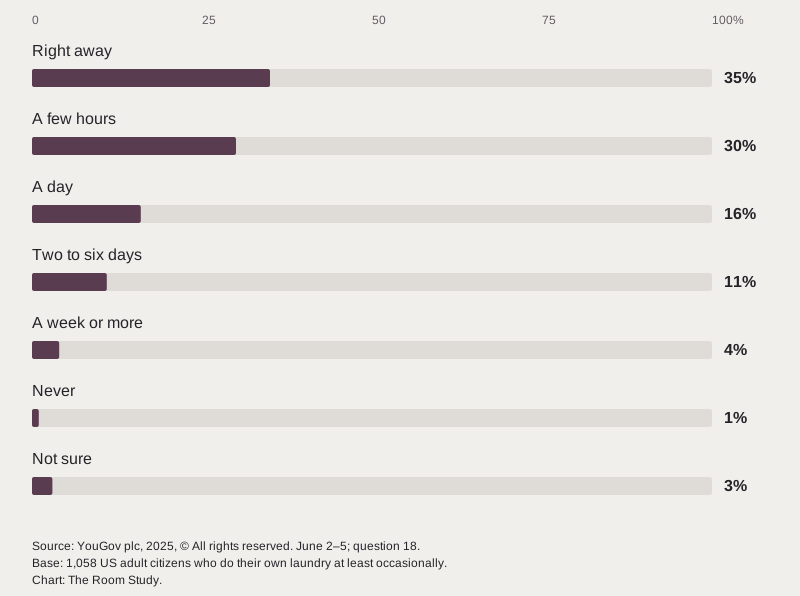
| Usual time after laundry is dry | Share | Included in the 31% taking a day or more? |
|---|---|---|
| Right away | 35% | No |
| A few hours | 30% | No |
| A day | 16% | Yes |
| Two to six days | 11% | Yes |
| A week or more | 4% | Yes |
| Never | 1% | No |
| Not sure | 3% | No |
Make room for the stage between dry and stored
If clean clothes regularly wait, include that stage when thinking about the room. Identify an accessible place that does not take away a seat, block a doorway or make clean and unwashed items difficult to distinguish. Its size should follow what your household actually has waiting, rather than the capacity of an attractive basket.
Then consider the journey onward. Laundry for several people may need to reach several drawers or closets. A single sorting place may suit one household; separate destinations may suit another. Those are choices to try against an ordinary load. The poll did not compare storage arrangements or test whether a particular one changes the time people take.
Find the step that is still unfinished
Before adding furniture, watch what happens to one load after it is dry. Does it need sorting, folding, carrying upstairs or space cleared in a drawer? Is someone else expected to collect it? These are distinct tasks, and the answer points to a more precise change than simply resolving to finish the laundry sooner.
My preference is to make the final destination easy to use before enlarging the temporary holding place. A generous basket can contain a wait neatly, but it does not decide who puts the contents away. If the aim is to reclaim a chair or bed, judge the arrangement by whether that surface becomes usable again.
Timing is not a verdict on the household
The study does not establish why people wait. It records neither the size of their homes nor the time, help or storage available to them in this question. It also does not say whether waiting clothes are folded, wrinkled, inside a basket or already being worn. Those details should not be added to the percentages.
The useful conclusion for a room plan is modest: allow for the whole route from washing to storage, including any stage that happens between them. A photograph of a utility space rarely shows how a completed load reaches the bedroom. Your own routine can supply that missing part of the brief.
Methodology & sources
YouGov fielded the poll online on 2–5 June 2025 and published its article on 1 August 2025. The overall sample was 1,119 US adult citizens. Question 18 was asked only of people who at least occasionally did their own laundry; its unweighted base was 1,058. The chart and all timing figures use that eligible group.
Respondents came from YouGov’s opt-in panel. Weighting included gender, age, race, education, presidential vote, turnout, party identification and voter registration; demographic targets came from the 2019 American Community Survey. The PDF reports an overall margin of error of ±3.8 percentage points, not a separate margin for this subgroup.
We checked question 18 in the original tables, PDF page 30 (printed table page 25), against YouGov’s article on 18 October 2026. Published whole percentages are retained. The 31% aggregate is explicitly published by YouGov and matches 16 + 11 + 4; we do not reconstruct an unrounded estimate or treat never as a finite waiting time.
Source: YouGov plc, 2025, © All rights reserved. This is a selected editorial presentation of one question, with original charting by The Room Study. The original poll and YouGov’s public-data terms are linked below.
We review these resources when the underlying releases change. A review date does not make a figure expire: its measurement period stays visible until a checked revision replaces it.
Laundry poll results, June 2–5, 2025
- Publisher
- YouGov
- Release
- 2025-08-01. Publication date follows YouGov’s accompanying article. Question 18 supplies the timing figures and eligibility base; the article explicitly publishes the combined 31% taking a day or more.
- Coverage
- United States. US adult citizens. The selected question is restricted to people who at least occasionally do their own laundry.. 2–5 June 2025 fieldwork.
- Method
- Online poll of YouGov’s opt-in panel, weighted using demographic and political variables. The reported overall margin of error is ±3.8 percentage points; no separate margin is supplied for the 1,058-person laundry subgroup. 1,119 US adult citizens overall; unweighted base of 1,058 for question 18 about putting dry clothes away..
- Reuse
- Source: YouGov plc, 2025, © All rights reserved. YouGov’s public-data terms permit standard commercial journalistic reporting, excluding full-dataset republication or replacement of its services. This page uses selected question aggregates with attribution. Source reuse information
Full poll tables (PDF) · YouGov’s report, 1 August 2025 · YouGov public-data terms
Cite this research
Credit the original source when using its estimates. For our derived comparisons, credit The Room Study analysis and retain the population and dates.
The Room Study (2026). When does the clean laundry get put away?. Published 18 October 2026. https://theroomstudy.com/statistics/us-laundry-habits. Based on YouGov data; measurement period: 2–5 June 2025 survey.
CSV: source estimates and The Room Study calculations. Please keep the source attribution and methodological notes with any reuse.