
The upfront cost of moving to a cheaper rental
United States · 2025 renter surveys; cash-savings context from 2022
Lower rent helps next month. The deposit is due now. That awkward difference is easy to miss when comparing two homes. Recent U.S. research shows how often renters face upfront charges; our calculator separates money paid early from money spent for good.
By The Room Study · Published
Data: 2025 renter surveys; cash-savings context from 2022 · Sources checked 23 October 2026
Key findings
83% of recent renters reported paying a security deposit in Zillow’s 2025 survey. Source
Link to finding23% of adult renters reported being behind on rent at some point in the year before the 2025 Federal Reserve survey, up from 21% in 2024. Source
Link to findingRenter households had median cash savings of $1,810 in 2022, according to Harvard’s analysis of the Survey of Consumer Finances. Source
Link to finding
A smaller monthly bill can need a bigger first payment
Moving creates two different questions: can the household assemble the cash needed before collecting the keys, and will the ongoing saving justify the costs that will not come back? Answering only the second can make an affordable-looking move impossible to start.
A refundable deposit ties money up. Advance rent changes when rent is paid. Application fees, a removal van and an extra week running two homes are costs to recover, if possible, from future savings. Treating all three as the same expense muddies the decision.
What recent renters were asked to pay
Zillow’s 2025 research puts deposits and application fees among the common entry costs of a rental. The chart concerns people who moved in the previous year, rather than every tenant in the country.
The same renter could appear in every bar. These figures describe how often a charge occurred, not the total price of a move or a rule that every landlord follows.
Upfront charges reported by recent renters
Zillow Consumer Housing Trends Report 2025. Respondents could report multiple charges; percentages do not sum to 100.

Source: Zillow, Consumer Housing Trends Report 2025, recent renters. Selected published aggregates; no new survey. Chart: The Room Study. Method and limits
Download chart (SVG)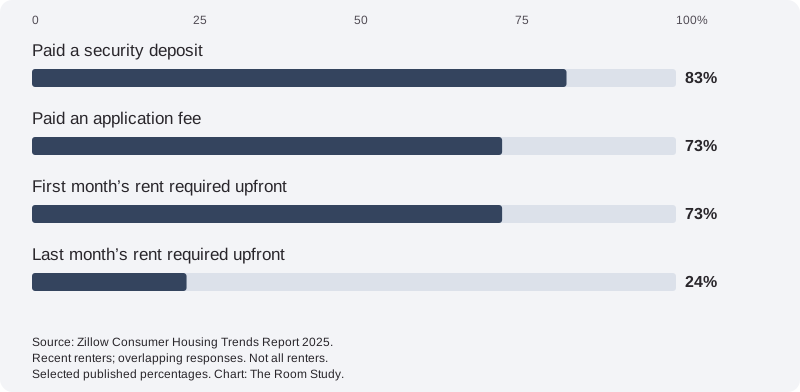
| Measure | Result | Population / period |
|---|---|---|
| Paid a security deposit | 83% | Recent renters; Zillow 2025 |
| Paid an application fee | 73% | Recent renters; Zillow 2025 |
| First month’s rent required upfront | 73% | Recent renters; Zillow 2025 |
| Last month’s rent required upfront | 24% | Recent renters; Zillow 2025 |
| Behind on rent at any point in preceding year | 23% | Adult renters; SHED October 2025 |
| Median cash savings | $1,810 | Renter households; Harvard analysis of 2022 SCF |
The savings cushion has its own date
Harvard’s $1,810 median cash-savings figure comes from the 2022 Survey of Consumer Finances. It is useful historical context for the difficulty of finding a large sum at once, but it is not a current bank balance for a typical 2025 mover.
We have not combined it with other survey medians to invent an average cash shortfall. Nor do rent-arrears figures establish that moving costs caused the arrears. The studies describe different parts of financial pressure, using different people and periods.
Compare the home, as well as the rent
A lower asking rent can come with different utility charges, parking, a longer journey or furniture that will not fit. List the recurring costs you can reasonably estimate on both sides. Keep any first-month concession separate from the amount due later.
For the move itself, ask for the charges and payment dates in writing. Do not count on a deposit refund arriving before the next deposit is required. The tool below uses the costs you enter; it cannot decide whether a charge is permitted locally or whether the new home is the right choice.
Would moving save you money?
Compare the cash needed to move with the costs your lower monthly bills could recover. Enter your own quotes; these fields are not national averages. Use 0 for charges that do not apply.
Your amounts stay in this page. This tool does not send, store or track them.
Methodology & sources
Zillow surveyed adult household decision makers through six online nonprobability surveys in March–July 2025, using quotas and weighting. Its recent-renter group moved within the previous year. The report gives overall study participation, not the unweighted base or confidence interval for each fee item. We reproduce the published incidence figures, without adding them or implying causation.
The Federal Reserve’s probability-panel survey measures adults. Its 23% rent-arrears estimate refers to any time in the year before October 2025, not the share presently behind. It must not be treated as the same population or sample as Zillow’s recent movers.
The $1,810 estimate is Harvard’s published renter-household cash-savings tabulation from the 2022 Survey of Consumer Finances. The blog does not expose the exact cash-account definition or computation, so we attribute it to Harvard rather than claiming independent replication. It is a nominal 2022 amount.
We omit a national moving-cost total. Harvard’s illustrative $3,670 bundles medians from different sources and years; it is not an observed median of household totals. Zillow’s prose and table also disagree on which deposit median applies to payers. That unresolved deposit amount is excluded from our chart, claims and downloadable data.
Calculator: upfront cash = refundable deposit + prepaid rent + non-refundable fees + moving + additional overlap + setup costs. Monthly saving = current recurring cost − new recurring cost. Break-even = non-recoverable costs ÷ positive monthly saving; equal or higher new costs have no break-even. First-year net saving = 12 × monthly saving − non-recoverable costs. Deposits and advance rent are excluded from break-even, assuming full refund and rent credited as intended; they remain in the upfront cash figure. The estimate excludes financing, lost interest, subsequent rent changes and uncertain deposit deductions.
We review these resources when the underlying releases change. A review date does not make a figure expire: its measurement period stays visible until a checked revision replaces it.
Economic Well-Being of U.S. Households in 2025: Housing
- Publisher
- Board of Governors of the Federal Reserve System
- Release
- 26 May 2026. 2025 survey estimates. Released percentages retained at their published whole-percent precision.
- Coverage
- United States. Adults age 18 and over. Each figure uses its stated subgroup: renters, homeowners or insured homeowners. These are not counts of dwellings or insurance policies.. Survey fieldwork 17–28 October 2025; rent arrears refer to the preceding year.
- Method
- Survey of Household Economics and Decisionmaking (SHED), administered by Ipsos through a probability-based online panel and weighted to represent U.S. adults. 12,934 adult respondents after quality exclusions. Housing chapter does not publish unweighted response counts for the selected items.
- Reuse
- Selected Federal Reserve published aggregates reproduced with attribution. No respondent records or source illustrations are redistributed.
Renters: Consumer Housing Trends Report 2025
- Publisher
- Zillow Group Population Science
- Release
- 27 October 2025. Fee-incidence figures checked against the original report. The deposit-median wording conflicts with a table, so that median is excluded here.
- Coverage
- United States. Adult household decision makers renting their primary residence; the selected fee figures concern recent renters.. March–July 2025 survey fieldwork; recent renters moved in the preceding year.
- Method
- Six online nonprobability surveys, using quotas and statistical raking to ACS and CPS benchmarks. Respondents could join more than one survey. Over 24,400 unique renter respondents, including over 5,700 recent renters, across six surveys; at least 6,500 responses per survey. These totals are not the response base of each selected fee item.
- Reuse
- Selected attributed factual aggregates only. Zillow retains rights in its report; no survey database, prose or original graphics are redistributed.
From Deposits to Fees, Renters Struggle with Up-Front Costs
- Publisher
- Harvard Joint Center for Housing Studies
- Release
- 16 March 2026. The $1,810 cash-savings estimate concerns 2022. Harvard’s illustrative $3,670 bundle combines separate amounts and years; it is not used here as a national moving-cost estimate.
- Coverage
- United States. Renter households in Harvard’s tabulation of the 2022 Survey of Consumer Finances.. 2022 Survey of Consumer Finances, analysed in 2026.
- Method
- Published Harvard analysis of the Federal Reserve Survey of Consumer Finances. The blog does not supply the code or detailed account definition behind its cash-savings figure. The renter subgroup count and item-specific uncertainty are not supplied in the blog; this figure has not been independently reproduced from microdata.
- Reuse
- One attributed factual aggregate from Harvard’s published analysis. No article text, licensed data or original chart is redistributed.
Cite this research
Credit the original source when using its estimates. For our derived comparisons, credit The Room Study analysis and retain the population and dates.
The Room Study (2026). The upfront cost of moving to a cheaper rental. Published 23 October 2026. https://theroomstudy.com/statistics/us-renting-moving-costs. Based on Board of Governors of the Federal Reserve System and Zillow Group Population Science and Harvard Joint Center for Housing Studies data; measurement period: 2025 renter surveys; cash-savings context from 2022.
CSV: source estimates and The Room Study calculations. Please keep the source attribution and methodological notes with any reuse.